


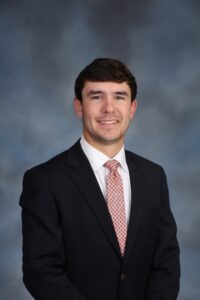
 Chance Loeffler is a 2025 alumnus of the Master of Forest Resources (MFR) program at the University of Georgia’s Warnell School of Forestry & Natural Resources and currently serves as a forester with Larson & McGowin. Through his work, Chance supports a diverse range of landowners and investors, applying the technical, analytical, and professional skills he developed during his time in the MFR program.
After completing his undergraduate studies at Auburn University, Chance was drawn to the MFR program by the opportunity to further explore his interest in forest investment at a nationally respected institution such as Warnell. Chance credits the Langdale Center for Forest Business as a major factor in his decision to attend Warnell, noting both the program’s academic rigor and its strong professional network as defining features of his graduate experience.
Chance shares: “The opportunity to immerse myself in a highly regarded forestry program through the Langdale Center for Forest Business really drew me in. I wanted to further my education and explore my interests in forest investment, but just as importantly, I wanted to build relationships with alumni, professors, and peers across the industry.”
While at Warnell, Chance attributes many of the skills he uses today to the coursework that blends forestry, business, and applied analysis. He emphasizes that the MFR program is practical in nature, as the curriculum, in partnership with the Terry College of Business, played a critical role in the preparation he needed to transition from student to professional. He says, “I still rely on the skills and experiences I developed at Warnell and Terry every week, whether I’m in the field or working in the office.”
Today, Chance works as a forester within Larson & McGowin’s forest management consulting practice, where no two days look the same. Chance’s role is to balance fieldwork, land management coordination, and office-based analysis and reporting. He notes that working in a professional services environment has exposed him to a wide range of landowner objectives, which reinforced the importance of adaptability, organization, and communication. “One of the biggest learning curves early in my career has been managing multiple projects simultaneously,” Chance notes. “There are aspects of this profession that simply can’t be replicated in a classroom, and learning to adapt to the pace and variety of consulting work has been meaningful.”
However, Chance credits the MFR program with the development of refined professional communication and organizational skills, which he considers to be among the most valuable of tools in his current role. These skills, accompanied by the technical forestry knowledge, have allowed Chance to contribute to the team in both the field and in client-facing settings.
In reflecting on his time at Warnell, Chance attributes the relationships he was able to make as the most influential aspect of his graduate experience. “Forestry is a relationship business; it’s very much a contact sport,” he explains. Through this experience, the lasting professional connections he built with classmates, faculty, and industry professionals have continued to shape his development as a forester and will remain a foundational part of his career.
Chance also speaks highly of the collaborative culture within the MFR program, noting that it mirrors the kind of environment students should expect once they become a professional in the forestry industry. He describes it as both competitive and supportive in nature and believes it is valuable to encourage students to challenge one another, share ideas, and grow.
For current MFR students preparing to enter the workforce, especially those interested in consulting, Chance’s advice was simple yet imperative: “Network, network, network.” Chance truly believes that your willingness to engage with other professionals across the industry will be essential to your success down the road.
Looking ahead, Chance is optimistic about the future of forestry. He believes that the industry is at “an inflection point,” where challenges within the industry will only be an opportunity for growth and innovation. “If you’re willing to step out of your comfort zone,” he says, “this is an exciting time to learn, grow, and make an impact as a young professional.”

