


📘 Read the full study in the Forest Engineering, Vol. 11:24 (2025): https://doi.org/10.1007/s40725-025-00256-6 or contact Dr. Chad Bolding or Dr. Joe Conrad for more information.
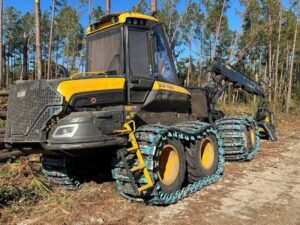 Cut-to-length (CTL) harvesting, developed in Scandinavia in the 1970s, is the predominant logging method in Nordic countries. Outside Scandinavia, however, adoption has been slow, even in regions where CTL offers clear advantages. A recent review by Chad Bolding, Joe Conrad, and our partners at the Sweden University of Agricultural Sciences and the Italian National Research Council examines why, exploring CTL’s evolution, benefits, barriers, and future opportunities.
CTL is a mechanized system using two machines: a harvester that fells, delimbs, and bucks trees at the stump, and a forwarder that transports logs to the landing. In contrast, full-tree systems that are common in the US South skid entire stems to landings for manual or knuckleboom loader processing. While full-tree systems are fast and cost-effective, CTL provides superior precision, safety, and environmental performance.
One major benefit is value recovery. CTL harvesters use computerized bucking to cut logs to exact lengths and diameters, compared to machine operator ocular estimates in full-tree systems. The CTL precision reduces waste and improves profitability for operations handling multiple assortments like sawtimber, pulpwood, and chip-n-saw.
Technology integration is advancing CTL further. GIS-based harvest planning and mapping, machine-to-machine communication, and LiDAR-assisted thinning help operators avoid sensitive areas, optimize routes, and select trees accurately. CTL also performs well on wet soils and moderate slopes, minimizes soil disturbance, and requires smaller landings.
Despite these strengths, CTL faces hurdles outside Scandinavia. High capital costs, specialized operator training needs, and complex repairs make it less competitive in regions where loggers are paid by cut-and-load rates. Market constraints add pressure: many mills in the US South prefer long stems and pay less for shorter logs, discouraging CTL adoption. With pulpwood making up 60% of harvest volume in some states, this pricing structure is a major barrier.
In European countries outside Scandinavia, major storms that caused wide-spread wind damage to forests accelerated CTL use, and today it accounts for 55–65% of harvests in Germany, France, and Italy. In the US South, CTL proved efficient in salvage logging following Hurricane Helene due to its ability to process downed stems and remove damaged trees. Still, regions like the US South with entrenched full-tree systems have supply chains built around that method and would require systemic changes for widespread CTL adoption.
Opportunities for CTL in the United States and the US South remain strong in niche applications such as sensitive sites, steep slopes, salvage operations, and small landings where its low ground pressure, compact footprint, and precision bucking deliver clear benefits. While not a universal solution, targeted use paired with operator training, tech integration, and market alignment can unlock efficiency and profitability. As forestry embraces sustainability and digital tools, CTL remains a key innovation poised to shape the future of timber harvesting.

